


 Taal
Taal

Ontvang een offerte
Copper Swage Sleeve: Properties, Finishes, Styles & Installation Guide
Copper has been the default material for wire rope swage sleeves in control, safety, and architectural cable systems for decades — and that preference is not arbitrary. The combination of ductility, shock resistance, and compatibility with galvanized steel wire rope makes copper sleeves the reliable choice for permanent terminations where consistent holding strength and a clean finish both matter. Understanding what distinguishes copper sleeves from other materials, and how surface treatment and sleeve style affect performance, is essential for anyone specifying or procuring wire rope assemblies.
What Is a Copper Swage Sleeve?
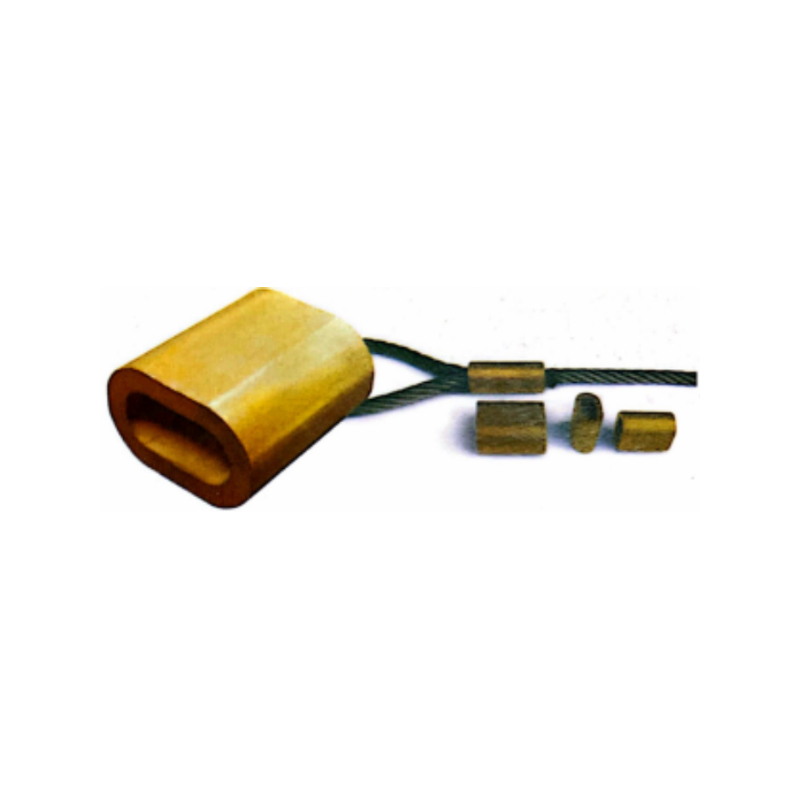
A copper swage sleeve is a short cylindrical or oval-shaped tube made from copper alloy, cold-pressed onto wire rope using a swaging tool to create a permanent mechanical termination. The sleeve is placed over the wire rope — either at the end to form a loop, or at a mid-point to create a lap splice — and then compressed with a die that deforms the copper tightly around the strand structure of the rope.
These fittings go by several names in the industry: ferrule sleeves, cable ferrules, crimp sleeves, and compression sleeves are all terms referring to the same component in different procurement and engineering contexts. Regardless of the name, the function is identical — to replace mechanical fasteners like wire rope clips with a cleaner, stronger, and more compact permanent connection.
Within the broader category of swage sleeves, copper sits between aluminum and stainless steel in terms of material strength and cost. It offers better ductility and shock load resistance than aluminum, while remaining more workable and economical than stainless steel. For wire rope fittings including thimbles, clips, and swaged termination hardware, copper sleeves are the standard selection across the widest range of general and light-industrial applications.
Why Copper: Material Properties That Matter
The case for copper over aluminum comes down to three specific material properties: ductility, shock load resistance, and galvanic compatibility with galvanized steel wire rope.
Ductility is the ability of a material to deform plastically under compressive force without cracking or fracturing. During swaging, the die compresses the sleeve wall inward, forcing copper to flow into the valleys between wire strands and conform tightly to the rope's helical structure. Copper's high ductility allows it to fill these interstitial spaces fully, maximizing the contact area between sleeve and rope. This intimate mechanical contact is what produces a termination capable of holding near the rated breaking strength of the wire rope when correctly installed. Aluminum is also ductile, but copper's greater malleability allows it to conform more completely under the same applied force.
Shock load resistance is the second advantage. Applications such as safety cables, fall arrest systems, and control cables on mechanical equipment are subject to sudden dynamic loads — forces that spike far above the static working load in a fraction of a second. Copper's resistance to slippage under shock loading is well established in field practice. Where aluminum sleeves may allow micro-movement between sleeve and rope under repeated dynamic loading, copper maintains its grip more consistently, preserving the integrity of the termination over the assembly's service life.
Galvanic compatibility addresses a practical constraint. Aluminum swage sleeves must not be used with stainless steel wire rope — prolonged contact between the two metals in the presence of moisture accelerates galvanic corrosion, progressively weakening the sleeve at the rope interface. Copper does not carry this restriction. It can be used with both galvanized steel wire rope and stainless steel cable, making it the more versatile material where rope type may vary across a project or production line. For galvanized and bright steel wire rope compatible with copper sleeve terminations, the material pairing is both mechanically sound and corrosion-safe.
Surface Finish Options: Plain, Zinc Plated, and Tin Plated
Copper swage sleeves are available in three surface conditions, each suited to different environmental exposures and aesthetic requirements. Selecting the right finish is not a cosmetic decision — it directly affects corrosion service life and long-term connection reliability.
| Finish | Corrosion Protection | Appearance | Best Suited For |
|---|---|---|---|
| Plain (bare copper) | Low — copper oxidizes to a patina over time | Bright copper tone, darkens with age | Dry indoor environments; applications where appearance is not critical |
| Zinc plated | Moderate — zinc sacrificial layer delays base metal corrosion | Bright silver finish, uniform and clean | Indoor/outdoor general use; moderate humidity; applications requiring an attractive finish |
| Tin plated | Moderate — tin layer provides barrier protection with low sheen | Flat, matte, non-reflective silver-grey | Applications where light reflection is undesirable; mil-spec and precision cable assemblies |
Plain copper is the economical baseline for indoor applications where the sleeve will not be exposed to moisture or corrosive environments. Zinc plating adds a sacrificial layer that delays base metal corrosion and provides an attractive, uniform silver finish — making it the most common choice for general-purpose assemblies where both performance and appearance matter. Tin plating offers similar corrosion protection with a flat, low-sheen surface that is specified in military cable assemblies and precision applications where reflective hardware would be a problem. Tin-plated sleeves also conform to MIL-SPEC requirements (MS51844 series) and are often required in government and defense procurement contexts.
Sleeve Styles and Sizing
Three sleeve styles are available in copper, each designed for a specific termination geometry and load requirement.
Oval sleeves (also called duplex sleeves) have an egg-shaped cross-section with a smooth outer face. They are the standard choice for creating loop-end terminations — the live end and dead end of the wire rope are both threaded through the sleeve, which is then swaged to form a secure eye. When correctly installed and load-tested, oval copper sleeves are capable of holding the full rated breaking strength of the matching wire rope. They are the workhorse sleeve style for the majority of control cable, safety cable, and rigging applications.
Hourglass sleeves (also called double barrel or duplex sleeves) feature two opposing longitudinal grooves that create a figure-eight profile. This geometry distributes compressive force more evenly across the sleeve body and produces the smoothest external crimp profile of the three styles. They function identically to oval sleeves in terms of holding strength and application range, and are often selected when a more streamlined appearance is required.
Stop sleeves are circular in cross-section and designed solely to terminate the end of a wire rope — preventing the rope from passing through a hole, panel, or fitting. They do not form loops and are not intended for load-bearing connections in the same sense as oval or hourglass sleeves. Stop sleeves are rated to approximately one-third the breaking strength of the matching rope and are used for light-duty applications such as anti-fray ends, cable anchor points, and panel retention systems.
Correct sizing is non-negotiable. Sleeve inner diameter must match the wire rope diameter precisely — an oversized sleeve will not grip the rope adequately regardless of how many crimps are applied, and an undersized sleeve cannot be fully compressed without damaging the rope. Standard copper swage sleeves are available to fit wire rope diameters from 1/16 inch through 1/2 inch, covering the full range of control, safety, and light rigging applications.
Key Applications for Copper Swage Sleeves
The properties of copper — ductility, shock resistance, finish options, and material compatibility — converge to make copper swage sleeves the preferred termination hardware across several distinct application categories.
Control cables in mechanical, automotive, and industrial equipment rely on copper swage sleeves for their ability to produce precise, repeatable loop-end dimensions. The controlled deformation of copper under swaging allows loop size to be held to tight tolerances, which matters in control systems where cable travel length affects actuator response. The clean crimp profile of hourglass and oval copper sleeves also reduces interference risk in confined routing paths.
Safety cables and fall arrest systems are applications where shock load performance is the defining requirement. A safety cable may see zero dynamic loading for months, then be subjected to a sudden arrest load that spikes the tension to multiples of the static working load. Copper's resistance to slippage under these conditions, combined with the inherent reliability of a properly swaged termination versus a clamp-type fitting, makes copper swage sleeves the standard hardware for fall arrest lanyards and restraint cable assemblies.
Architectural cable systems — balustrades, cable railings, tension facades, and decorative cable screens — specify copper swage sleeves for their combination of reliable mechanical performance and finish quality. Zinc-plated copper sleeves in particular provide a clean, consistent appearance that integrates with brushed stainless and powder-coated hardware without introducing visual inconsistency. The slim profile of swaged terminations also suits the aesthetic requirements of architectural applications better than bulky clip-type fittings.
For broader cable assembly requirements across these sectors, wire rope accessories such as sleeves, shackles, and lifting rings provide the complete range of hardware needed to build and connect finished assemblies.
Installation Guidelines and Common Mistakes
A copper swage sleeve is only as reliable as its installation. The mechanical performance of the termination depends on correct sleeve selection, proper rope insertion, crimp sequence, and pre-service load testing — none of which can be skipped without compromising the assembly's rated capacity.
The dead end of the wire rope — the non-load-bearing tail that passes back through the sleeve — must protrude at least two rope diameters beyond the end of the sleeve after swaging. This tail allowance ensures that the sleeve remains in full contact with the rope as the copper expands slightly during crimping. A tail that is too short results in a partial grip that reduces holding strength below the rated value.
The number of crimps required increases with sleeve size. Smaller sleeves (1/16 inch to 3/32 inch) typically require two crimps; larger sleeves up to 3/8 inch may require three or more. The crimp sequence — starting from the loop end of the sleeve and working toward the dead end — is also specified and must be followed. Applying crimps in the wrong order can cause the rope to walk within the sleeve during compression, creating internal misalignment that is not visible externally but reduces holding strength.
Load testing every assembly before putting it into service is mandatory. Swaged connections that appear correctly installed can still fail at below-rated loads if the rope was not fully seated, the wrong sleeve was used, or the swaging tool was not properly calibrated. A proof load test — applying a specified tensile load and holding it for a defined period — confirms the assembly performs as intended before it is placed under working conditions. This requirement applies regardless of application type, from lightweight control cables to fall protection assemblies.
Hand swagers are suitable for copper sleeves up to approximately 3/16 inch in diameter; larger sizes require bench-mounted or hydraulic swaging equipment to generate the compressive force needed to fully deform the sleeve wall. Using an undersized tool on a larger sleeve produces an incomplete crimp that looks correct but retains significantly less than the rated capacity of the termination.
Neem contact met ons op
-

-
 +86-13395162883 / +86-0510-86361180
 -
 Nr. 25 Xizhang Road, Changshou Village, Zhouzhuang Town, Jiangyin City, Wuxi City, Jiangsu Province, China

- Snelle koppelingen
- Productcategorieën
- Staalkabel
- Draadkabelfittingen
- Keten
- Accessoires voor draadkabels
- Verpakkingstypen

Stuur ons nu een bericht!
